
Andrew Cockburn gives us an excellent short history of Biden's disastrous career. Any Democrat who actually reads the whole article should come away believing that the idea that Biden is at all electable, and the best choice to beat Trump in 2020, is a potentially devastating myth, much like the 2016 myth that Hillary Clinton was the best choice for the nomination.
The Dem leadership seems to want to pick the most right-wing candidate possible and hope that enough liberal Dems are disgusted more by the GOP candidate to actually vote. But for Russian interference, this tactic would have worked in 2016. It will not work in 2020:
"Regardless of the current election cycle’s endgame, though, it’s safe to assume that [Biden's] undimmed ego will never permit any reflection on whether voters who have been eagerly voting for change will ever really settle for Uncle Joe, champion of yesterday’s sordid compromises."
It seems to me that it would be a lot smarter to put forward a candidate who does not have a disastrous legislative and campaigning history, and who does not say and do idiotic and morally corrupt things on a regular basis.
(All emphases below are mine.)
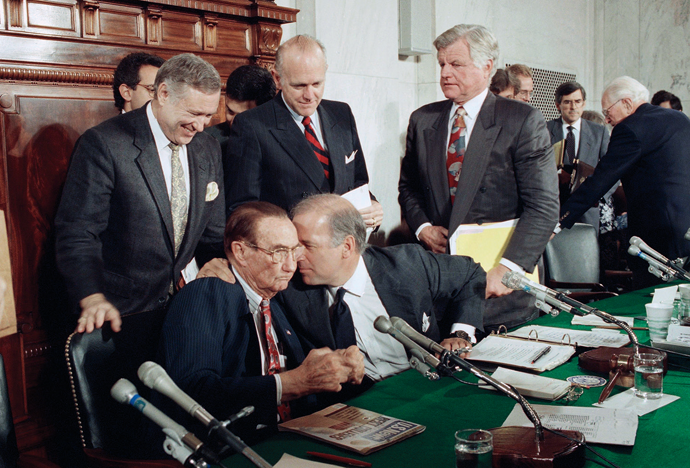
Senator Joe Biden huddles with Senator Strom Thurmond after the Judiciary Committee voted 7–7 on the nomination of Clarence Thomas to the Supreme Court, September 1991 © AP Photo/John Duricka
By Andrew Cockburn. Harper's Magazine, June 23, 2019.
... Despite pleas from the NAACP and the ACLU, the 1990s brought no relief from Biden’s crime crusade. He vied with the first Bush Administration to introduce ever more draconian laws, including one proposing to expand the number of offenses for which the death penalty would be permitted to fifty-one. Bill Clinton quickly became a reliable ally upon his 1992 election, and Biden encouraged him to “maintain crime as a Democratic initiative” with suitably tough legislation. The ensuing 1994 Violent Crime Control and Law Enforcement Act, passed with enthusiastic administration pressure, would consign millions of black Americans to a life behind bars.
In subsequent years, as his crime legislation, particularly on mandatory sentences, attracted efforts at reform, Biden began expressing a certain remorse. “I am part of the problem that I have been trying to solve since then, because I think the disparity [between crack and powder cocaine sentences] is way out of line,” he declared at a Senate hearing in 2008. However, there is little indication that his words were matched by actions, especially after he moved to the vice presidency the following year. The executive director of the Criminal Justice Policy Foundation, Eric Sterling, who worked on the original legislation in the House as a congressional counsel, told me, “During the eight years he was vice president, I never saw him take a leadership role in the area of drug policy, never saw him get out in front on the issue like he did on same-sex marriage, for example. Biden could have taken a stronger line [with Obama] privately or publicly, and he did not.”
While many black Americans will neither forgive nor forget how they, along with relatives and friends, were accorded the lifetime stigma of a felony conviction, many other Americans are only now beginning to count the costs of these viciously repressive initiatives. As a result, criminal justice reform has emerged as a popular issue across the political spectrum, including among conservatives eager to burnish otherwise illiberal credentials. Ironically, this has led, in theory, to a modest unraveling of a portion of Biden’s bipartisan crime-fighting legacy.
... In the near term, it’s unlikely that there will be further bipartisan attempts to chip away at Biden’s legislative legacy, a legacy that includes an inconsistent (to put it mildly) record on abortion rights. Roe v. Wade “went too far,” he told an interviewer in 1974. “I don’t think that a woman has the sole right to say what should happen to her body.” For some years his votes were consistent with that view. He supported the notorious Hyde Amendment prohibiting any and all federal funding for abortions, and fathered the “Biden Amendment” that banned the use of US foreign aid for abortion research.
As the 1980s wore on, however, and Biden’s presidential ambitions started to swell, he began to cast fewer antiabortion votes (with some exceptions) ... Then came Clarence Thomas. Even before Anita Hill reluctantly surfaced with her convincing recollections of unpleasant encounters with the porn-obsessed judge, Biden was fumbling his momentous responsibility of directing the hearings. As Jane Mayer and Jill Abramson report in Strange Justice, their book about the Thomas nomination battle, Biden’s questions were “sometimes so long and convoluted that Thomas would forget what the question was.” Biden prided himself on his legal scholarship, Mayer and Abramson suggest, and thus his questions were often designed “to show off [his] legal acumen rather than to elicit answers.”
More damningly, Biden not only allowed fellow committee members to mount a sustained barrage of vicious attacks on Hill: he wrapped up the hearings without calling at least two potential witnesses who could have convincingly corroborated Hill’s testimony and, by extension, indicated that the nominee had perjured himself on a sustained basis throughout the hearings.
... Biden’s record on race and women did him little damage with the voters of Delaware, who regularly returned him to the Senate with comfortable margins. On race, at least, Biden affected to believe that Delawareans’ views might be closer to those of his old buddy Thurmond than those of the “Northeast liberal” he sometimes claimed to be. “You don’t know my state,” he told Fox as he geared up for his second attempt on the White House in 2006. “My state was a slave state. My state is a border state. My state has the eighth-largest black population in the country. My state is anything [but] a Northeast liberal state.” Months later, in front of a largely Republican audience in South Carolina, he joked that the only reason Delaware had fought with the North in the Civil War was “because we couldn’t figure out how to get to the South. There were a couple of states in the way.”
Whether or not most Delawareans are proud of their slaveholding history, there are some causes that they, or at least the dominant power brokers in the state, hold especially dear. Foremost among them is Delaware’s status as a freewheeling tax haven. State laws have made Delaware the domicile of choice for corporations, especially banks, and it competes for business with more notorious entrepôts such as the Cayman Islands. Over half of all US public companies are legally headquartered there.
“It’s a corporate whore state, of course,” the anonymous former Biden staffer remarked to me offhandedly in a recent conversation. He stressed that in “a small state with thirty-five thousand bank employees, apart from all the lawyers and others from the financial industry,” Biden was never going to stray too far from the industry’s priorities. We were discussing bankruptcy, an issue that has highlighted Biden’s fealty to the banks. Unsurprisingly, Biden was long a willing foot soldier in the campaign to emasculate laws allowing debtors relief from loans they cannot repay. As far back as 1978, he helped negotiate a deal rolling back bankruptcy protections for graduates with federal student loans, and in 1984 worked to do the same for borrowers with loans for vocational schools. Even when the ostensible objective lay elsewhere, such as drug-related crime, Biden did not forget his banker friends. Thus the 1990 Crime Control Act, with Biden as chief sponsor, further limited debtors’ ability to take advantage of bankruptcy protections.
These initiatives, however, were only precursors to the finance lobby’s magnum opus: the 2005 Bankruptcy Abuse Prevention and Consumer Protection Act. This carefully crafted flail of the poor made it almost impossible for borrowers to get traditional “clean slate” Chapter 7 bankruptcy, under which debt forgiveness enables people to rebuild their lives and businesses. Instead, the law subjected them to the far harsher provisions of Chapter 13, effectively turning borrowers into indentured servants of institutions like the credit card companies headquartered in Delaware. It made its way onto the statute books after a lopsided 74–25 vote (bipartisanship!), with Biden, naturally, voting in favor.
It was, in fact, the second version of the bill. An earlier iteration had passed Congress in 2000 with Biden’s support, but President Clinton refused to sign it at the urging of the first lady, who had been briefed on its iniquities by Elizabeth Warren. A Harvard Law School professor at the time, Warren witheringly summarized Biden’s advocacy of the earlier bill in a 2002 paper:
"His energetic work on behalf of the credit card companies has earned him the affection of the banking industry and protected him from any well-funded challengers for his Senate seat."
Furthermore, she added tartly, “This important part of Senator Biden’s legislative work also appears to be missing from his Web site and publicity releases.” No doubt coincidentally, the credit card giant MBNA was Biden’s largest contributor for much of his Senate career, while also employing his son Hunter as an executive and, later, as a well-remunerated consultant.
It should go without saying, then, that Biden was among the ninety senators on one of the fatal (to the rest of us) legislative gifts presented to Wall Street back in the Clinton era: the Gramm–Leach–Bliley Act of 1999. The act repealed the hallowed Depression-era Glass–Steagall legislation that severed investment banking from commercial banking, thereby permitting the combined operations to gamble with depositors’ money, and ultimately ushering in the 2008 crash. “The worst vote I ever cast in my entire time in the United States Senate,” admitted Biden in December 2016, as he prepared to leave office. Seventeen years too late, he explained that the act had “allowed banks with deposits to take on risky investments, putting the whole system at risk.”
... Biden’s claims of experience on the world stage, therefore, cannot be denied. True, the experience has been routinely disastrous for those on the receiving end, but on the other hand, that is a common fate for those subjected, under any administration, to the operations of our foreign policy apparatus.
... Given Biden’s all too evident shortcomings in the fields of domestic and foreign policy, defenders inevitably retreat to the “electability” argument, which contends that he is the only Democrat on the horizon capable of beating Trump—a view that Biden, naturally, endorses.
... Another gaffe helped upend Biden’s second White House bid, in 2007, when he referred to Barack Obama in patronizing terms as “the first mainstream African American who is articulate and bright and clean and a nice-looking guy.”
... Regardless of the current election cycle’s endgame, though, it’s safe to assume that his undimmed ego will never permit any reflection on whether voters who have been eagerly voting for change will ever really settle for Uncle Joe, champion of yesterday’s sordid compromises.

No comments:
Post a Comment